


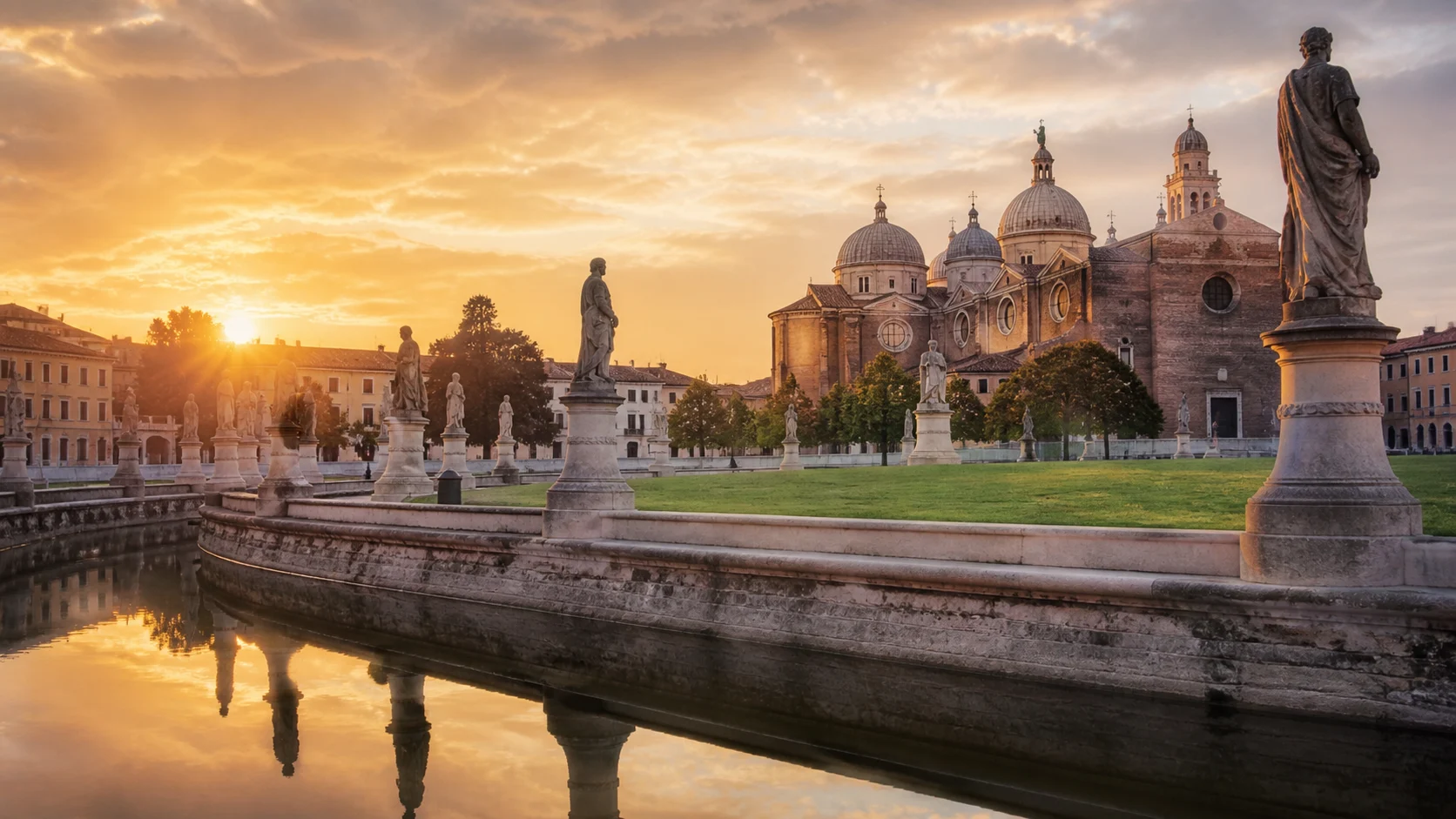
At Tailor Homes we’ve built our medium-term rental business around exactly this insight: stay in one apartment, unpack once, and use the trains. This is the guide we share with our guests when they ask what to do beyond the city itself.
Three things matter: a major rail hub (Padova Centrale connects to almost everywhere in northern Italy directly), a price gap (apartments and meals are roughly half what you’d pay in Venice), and the quality of the city itself (you’ll want to come back to it every evening). For stays of three nights or more, basing in Padova is almost always the right answer.
1. Venice — The Obvious First Trip
The single most popular day trip from Padova, and rightly so. Direct trains from Padova Centrale to Venezia Santa Lucia run every fifteen minutes, take half an hour, and cost as little as €4.50 second class. Regional trains are cheaper and frequent enough that you don’t need to plan around them.
The pattern that works: arrive early (around 9am), do the Doge’s Palace and St Mark’s before the cruise crowds peak, lunch in Cannaregio away from the tourist drag, an afternoon vaporetto along the Grand Canal, evening cicchetti and home for a quiet dinner in Padova. You’ll have seen Venice properly without sleeping there — and your accommodation will have cost a third of a Venetian equivalent.
2. Vicenza — Palladio’s Workshop
Half an hour west by train, Vicenza is the home city of Andrea Palladio, the architect whose buildings shaped Western architecture for the next 500 years — Thomas Jefferson’s Monticello, the White House, every neoclassical bank facade in London, all of them owe Palladio. The city is essentially an open-air museum of his work.
The unmissable sights: the Basilica Palladiana (his early masterpiece, on the central piazza), the Teatro Olimpico (the oldest surviving covered theatre in Europe, with permanent stage scenery from 1585), and a walk along Corso Palladio. With more time, the Villa Rotonda sits a short bus ride out of town — perhaps the single most influential country house ever built.
3. Verona — Roman Theatre, Romeo’s Balcony, Wine
Verona is bigger and more touristed than Padova, but it absorbs visitors well thanks to a superb Roman amphitheatre still in use, a beautiful old town wrapped in the curve of the Adige river, and (yes) the disputed Casa di Giulietta. The Arena di Verona hosts an internationally famous opera season from June to early September — even one performance is a memorable evening.
Pair Verona with a half-day in Valpolicella wine country (a fifteen-minute drive into the hills above the city) — the home of Amarone, Recioto, and Valpolicella Ripasso. Many local wineries take walk-in tastings; book ahead for the famous estates.
4. The Euganean Hills — Wine, Walking, Thermal Spas
Padova sits at the edge of the Euganean Hills, a volcanic landscape of vineyards, walled medieval villages, and Italy’s most important thermal-spa towns (Abano Terme and Montegrotto Terme). It’s a half-day’s worth of countryside fifteen minutes from the city centre, ideal for a slower afternoon between sights.
Three highlights: Arquà Petrarca, where the poet Petrarch lived his last years — one of the most beautiful villages in Italy, with Petrarch’s house preserved as a museum. Monselice, a fortified medieval town with a ridge-top castle and an extraordinary processional sanctuary climb. And the wineries themselves — the Colli Euganei DOC produces excellent Cabernet, Merlot, and the local Fior d’Arancio dessert wine.
5. Riviera del Brenta — A Boat Cruise to Venice
The Burchiello is a slow boat cruise that travels the historic canal between Padova and Venice — the route the Venetian aristocracy used for their summer villas. The full-day tour leaves Padova in the morning, passes Palladian villas (including the famous Villa Foscari “La Malcontenta”, designed by Palladio in 1560), stops for a guided villa visit and lunch, and arrives in Venice late afternoon.
It’s the quietest, most atmospheric way to enter Venice — and a complete day-trip experience in itself. Operates Tuesday–Sunday from late March to early November; book at least a week ahead in summer.
6. The Lesser-Known Trips
Treviso (30 min)
Smaller and quieter than Verona — a charming walled city of canals, frescoed facades, and a serious food scene. Treviso is the centre of radicchio production and the home of true tiramisù. A half-day is enough.
The Prosecco hills (1 hr 15)
Drive north from Padova for an hour and you’re in Conegliano-Valdobbiadene — the UNESCO-listed prosecco hills. A landscape of vine-covered ridges, small family wineries, and excellent agriturismo restaurants. Best by car; some tour operators run day trips from Padova.
Bologna (1 hr)
An hour by direct high-speed train. A complete change of pace — bigger, denser, with one of the best food cultures in Italy. The Two Towers, the Quadrilatero food market, and lunch at any reputable osteria justify the trip.
The Dolomites (2 hr 30 by train + bus)
A long day, but possible. Take the train to Belluno, change for a bus to Cortina d’Ampezzo. More realistic as an overnight than a day-trip, but achievable for a glimpse if your trip is short.
How to Plan a Day Trip Properly
Three things make day trips from Padova significantly better:
Buy regional train tickets at the machine, not the counter. Queues are long and unnecessary. The yellow Trenitalia machines take cards and have an English option. Tickets must be validated in the small green-and-white machines on the platform before boarding — small fines apply if you forget.
Check the strike calendar. Italian rail strikes (scioperi) are announced weeks ahead and follow regular patterns. The Trenitalia website lists them. Friday strikes are common; weekday strikes typically have guaranteed-service windows in the morning and evening.
Don’t pack the schedule. The temptation with Veneto is to try and see Venice, Vicenza, Verona, and the hills in four days. The result is exhausting and superficial. One excursion per two days, with a slow day in Padova between, is the rhythm that actually works.
Why This Pattern Suits Medium-Term Stays
What our medium-term guests realise within a week or two: the day-trip approach turns a three-week visit to Italy into something far richer than three separate cities visited consecutively. You unpack once. You build a daily rhythm in Padova. You take three or four excursions a week. You actually see the region.
This is why a furnished apartment for a month in Padova consistently outperforms equivalent stays based in Venice or split across multiple cities. We’ve documented the cost difference in our short stay vs monthly rental guide; the experiential difference is even bigger.
Make Padova your base for the Veneto.
Furnished apartments by the night, the week, or the month. Direct trains everywhere worth going. Local team to point you in the right direction.
Find Your Padova Apartment →